Becoming a truck driver in the United States can open the door to a career that does not necessarily require a four-year college degree and offers opportunities in almost every part of the country.
Truck drivers move food, construction materials, retail products, machinery, automobiles, fuel, consumer goods, and thousands of other products between factories, warehouses, ports, distribution centers, stores, and customers. Without commercial drivers, much of the American supply chain would stop moving.
But becoming a professional semi-truck driver requires more than learning how to operate a large vehicle.
Most people who want to drive tractor-trailers need a Class A Commercial Driver's License (CDL). New applicants generally need to obtain a Commercial Learner's Permit, complete applicable Entry-Level Driver Training, pass a three-part CDL skills test, meet medical requirements, and satisfy the hiring standards of a trucking company.
The process is manageable, but the exact details vary somewhat by state because CDLs are issued by state governments rather than directly by the Federal Motor Carrier Safety Administration.
According to the latest Bureau of Labor Statistics occupational wage data, the United States employed approximately 2.06 million heavy and tractor-trailer truck drivers in May 2025, with a national mean annual wage of approximately $59,710. Actual income varies significantly based on experience, location, freight type, employer, endorsements, mileage, and whether a driver works local, regional, or OTR.
If you are starting from zero, here is how the process works.
Step 1: Decide What Type of Truck Driver You Want to Become
Before enrolling in a CDL school, decide what kind of commercial driving you actually want to do.
This matters because the type of vehicle determines which CDL class you need.
For someone who wants to drive the large tractor-trailers commonly seen on American Interstate highways, Class A is generally the most useful choice.
A Class A CDL is designed for qualifying combinations of vehicles and is the license commonly associated with semi-trucks, dry vans, refrigerated trailers, flatbeds, tankers, and many other tractor-trailer operations.
Class B is more commonly associated with certain heavy single vehicles such as straight trucks, large dump trucks, some buses, and other commercial vehicles that do not fall into the Class A combination category.
Class C covers certain commercial vehicles that do not meet the Class A or B definitions but require a CDL because of passenger capacity or regulated hazardous-material transportation.
For most people whose goal is:
“I want to become a semi-truck driver,”
Class A is the logical starting point.
It usually provides the broadest range of traditional trucking career options.
Before beginning training, also think about what type of job you eventually want.
OTR trucking means long-distance routes and can involve spending days or weeks away from home.
Regional trucking normally keeps drivers within a specific area of the country and may provide more frequent home time.
Local trucking often allows drivers to return home daily but may involve more city driving, backing, deliveries, and customer interaction.
You do not have to make a permanent career decision before CDL school, but having a general direction can help you choose the right training and endorsements.
Step 2: Check the CDL Requirements in Your State
The federal government establishes minimum CDL standards, but individual states issue commercial driver's licenses.
FMCSA therefore recommends that prospective drivers begin by obtaining the CDL manual published by their State Driver Licensing Agency.
That may be your DMV, BMV, DPS, MVD, or another state agency depending on where you live.
Your state's CDL manual explains:
- CDL classes
- Knowledge tests
- Permit procedures
- Required documents
- State fees
- Skills testing
- Endorsements
- Restrictions
- State-specific rules
Federal requirements create a common foundation across the country, but states can impose requirements beyond the federal minimum.
For example, training documentation, testing appointments, application procedures, and fees can vary from one state to another.
Do not rely entirely on a CDL school advertisement or a video made several years ago.
Use your current state CDL manual as one of your primary resources.
FMCSA also makes an important point that new drivers sometimes misunderstand: FMCSA itself does not issue your CDL. Your state licensing agency does.
How Old Do You Have to Be to Become a Truck Driver?
Age can significantly affect the type of trucking job available to you.
Under the standard federal rule, a commercial driver generally must be at least 21 years old to operate a commercial motor vehicle in interstate commerce.
Drivers ages 18 through 20 may obtain a CDL and operate commercially within a state when permitted under that state's rules, but traditional interstate trucking normally requires the driver to be 21.
That distinction is important.
Intrastate commerce generally means qualifying transportation that remains within the state.
Interstate commerce includes transportation connected with commerce between states or internationally and is the category associated with most nationwide OTR trucking.
There are limited federal programs or exceptions that can affect certain younger drivers, but someone planning a normal nationwide OTR career should generally expect age 21 to be the important threshold.
Step 3: Meet the Medical Requirements
Professional truck driving can involve long hours, heavy equipment, night driving, difficult weather, and vehicles weighing tens of thousands of pounds.
Medical qualification is therefore part of the process for many commercial drivers.
FMCSA states that commercial drivers operating qualifying vehicles in interstate commerce are generally required to maintain appropriate medical qualification. For CDL holders, this also involves self-certifying the type of commercial driving they perform with their State Driver Licensing Agency.
For a typical interstate Class A truck driver, this usually means completing a DOT physical examination with a qualified medical examiner.
The examination evaluates areas relevant to safely operating a commercial vehicle.
Depending on applicable requirements, these can include areas such as vision, hearing, blood pressure, cardiovascular health, neurological conditions, medications, and other factors that could affect safe driving.
If the driver meets the applicable requirements, the examiner can issue a Medical Examiner's Certificate, often informally called a DOT medical card.
Do not assume that every applicant automatically receives the same certification period. The medical examiner may issue a certificate for a shorter period when a condition requires more frequent monitoring.
If you are planning to enter trucking, it can be useful to investigate your medical qualification relatively early rather than spending significant money on training before discovering an unresolved qualification issue.
Step 4: Get Your Commercial Learner's Permit
Before you can obtain a full CDL, you normally begin with a Commercial Learner's Permit, or CLP.
Think of the CLP as the commercial equivalent of a learner's permit.
It allows you to practice operating the appropriate commercial vehicle on public roads when accompanied by a qualified CDL holder as required.
To obtain the permit, applicants normally study their state CDL manual and pass the required knowledge tests for the type of CDL they are seeking.
A future Class A tractor-trailer driver will normally study areas such as:
- General commercial-driving knowledge
- Combination vehicles
- Air brakes when applicable
- Vehicle inspections
- Safe operating practices
Additional written tests are required for certain endorsements.
FMCSA notes that obtaining the CLP involves more than simply passing the knowledge tests. States also verify eligibility information, and an applicant's driving record is checked across the states and District of Columbia as part of the process. Applicants must also provide the documents required by their state and demonstrate medical qualification where applicable.
Once you receive the CLP, you can begin the practical portion of learning how to drive a commercial vehicle.
Step 5: Complete Entry-Level Driver Training
One of the most important current requirements for new CDL applicants is Entry-Level Driver Training, commonly called ELDT.
Federal ELDT regulations apply to drivers who are obtaining:
- A Class A CDL for the first time
- A Class B CDL for the first time
- A Class A CDL by upgrading from Class B
- A Passenger endorsement for the first time
- A School Bus endorsement for the first time
- A Hazardous Materials endorsement for the first time
The current ELDT requirements have applied since February 7, 2022.
When ELDT applies, you cannot simply receive informal instruction from anyone with a truck and then take the required test.
The required training must be completed through a provider listed in FMCSA's Training Provider Registry, or TPR.
The provider submits your successful training completion electronically to FMCSA, and the state verifies that information before allowing you to proceed with the applicable test.
The Training Provider Registry currently contains thousands of active providers and locations around the country.
Choosing a CDL School
Do not automatically select the cheapest training provider.
A CDL school can affect how prepared you are for your first trucking job.
Ask how much actual behind-the-wheel time students receive.
Find out how many students share each truck.
Ask whether training includes:
- Pre-trip inspections
- Straight-line backing
- Offset backing
- Dock-style backing
- Road driving
- Turns
- Interstate driving
- Shifting if training on a manual transmission
- Coupling and uncoupling
- Air-brake procedures
- Realistic vehicle-control practice
Also verify that the provider is actually listed in the Training Provider Registry for the training you need.
FMCSA specifically advises applicants to research providers carefully, compare programs, understand fees, check state-specific requirements, and verify that the school can provide the required type of training.
Does ELDT Require a Certain Number of Training Hours?
The federal ELDT framework is based heavily on required curriculum and demonstrated proficiency rather than creating one universal number of classroom and driving hours that applies to every student in every state.
States can impose additional requirements.
That means one CDL program may be structured differently from another.
The fastest program is therefore not necessarily the best program.
You are learning to operate a vehicle that may eventually weigh close to 80,000 pounds in normal Interstate service.
Getting enough quality practice matters far more than finishing several days sooner.
Step 6: Learn to Actually Drive a Tractor-Trailer
Passing written tests is only a small part of becoming a professional truck driver.
The difficult part for most beginners is learning how a tractor-trailer behaves.
The vehicle is long.
It is wide.
The trailer does not follow exactly the same path as the tractor.
Turns require additional room.
Stopping distances are much longer than in a passenger vehicle.
Backing requires controlling two connected vehicles at the same time.
During CDL training, you will begin developing skills such as mirror use, lane positioning, speed management, turning, backing, shifting when applicable, coupling, inspections, and overall vehicle control.
Backing is often one of the most frustrating skills for new students.
At first, the trailer may seem to move in exactly the opposite direction you want.
That is normal.
The solution is repetition.
Students gradually learn to recognize how steering input changes the angle between the tractor and trailer. They begin understanding when to correct, when to follow the trailer, when to pull forward, and when to GOAL — Get Out And Look.
The goal is not to memorize one steering-wheel formula.
Real loading docks do not look like training cones.
You need to understand what the trailer is doing.
Manual vs. Automatic Transmission CDL Training
Another decision involves the transmission.
Automated manual transmissions are now extremely common in large American trucking fleets. Trucks such as Freightliner Cascadias and Volvo VNLs are frequently equipped with automated transmissions.
That means someone can build an entire trucking career without regularly operating a traditional manual gearbox.
However, CDL restrictions matter.
If you take the skills test in a vehicle that does not meet particular equipment requirements, restrictions can appear on your license. FMCSA specifically advises applicants to take the test in the type of vehicle they expect to be qualified to operate if they want to avoid relevant restrictions.
For a new driver, this creates a practical decision.
Training and testing on an automatic may be easier and may be perfectly sufficient for the company you want to work for.
Training on a manual can preserve additional flexibility if you later want a job using manual-transmission equipment.
There is no correct choice for everyone.
Think about the employers and trucking segments you may want to enter later.
Step 7: Hold the CLP Long Enough and Take the CDL Skills Test
Receiving your CLP does not mean you can immediately take the final CDL test the following morning.
Under the federal framework, you generally must hold the CLP for at least 14 days before becoming eligible for the CDL skills test. Applicable ELDT must also be completed.
FMCSA describes the current CDL skills test as having three major parts:
Vehicle Inspection Test
You demonstrate that you understand how to inspect the commercial vehicle and identify important safety-related components.
Basic Controls Test
You demonstrate basic control of the truck through required maneuvering exercises.
Road Test
You operate the commercial vehicle in real traffic while demonstrating safe vehicle control.
You need to pass the required portions of the skills test according to your state's procedures.
If you fail, do not treat it as proof that trucking is not for you.
Many capable drivers struggle with parts of CDL testing, particularly backing or the vehicle inspection portion.
Use the failed attempt to identify what needs more practice.
Step 8: Receive Your Class A CDL
Once you have successfully completed the applicable tests and state requirements, the State Driver Licensing Agency can issue your CDL.
At this point, check the license carefully.
Verify your name, CDL class, endorsements, and restrictions.
A small administrative error can become much more frustrating after you leave the licensing office.
Receiving the CDL is a major achievement.
But it does not mean that you are now an experienced truck driver.
You have demonstrated the minimum qualifications necessary to obtain the commercial license.
The next stage is learning how professional trucking actually works.
Should You Get CDL Endorsements?
Endorsements can expand the types of commercial vehicles and freight you are qualified to operate.
Common endorsements include:
N — Tank Vehicle
Used for qualifying tank vehicles.
H — Hazardous Materials
Required for certain transportation of hazardous materials.
X — Tanker and Hazmat
Combines the N and H qualifications.
T — Double/Triple Trailers
Used for qualifying double and triple trailer combinations where legal.
P — Passenger
Used for qualifying passenger operations.
S — School Bus
Required for applicable school-bus driving.
For someone pursuing ordinary dry-van OTR trucking, you may not need every endorsement immediately.
However, endorsements can make additional jobs available later.
Tanker and Hazmat qualifications, for example, can be valuable in specialized transportation.
Remember that first-time H, P, and S endorsements are covered by ELDT requirements.
Choose endorsements because they match your career goals — not simply because you want every possible letter printed on your CDL.
Step 9: Apply to Trucking Companies That Hire New Drivers
This is where many new CDL holders become frustrated.
They receive a Class A CDL and then discover that many attractive job listings require:
“6 months experience.”
“12 months verifiable tractor-trailer experience.”
“2 years preferred.”
That does not mean no one hires beginners.
Many larger carriers operate programs specifically for new CDL graduates.
Search for terms such as:
- Recent CDL graduate
- Entry-level CDL-A driver
- Student driver
- CDL-A trainee
- No experience required
- Paid driver training
For your first company, training quality may be more important than receiving the absolute highest advertised cents-per-mile rate.
A carrier that gives you good equipment, competent instruction, realistic dispatch, and several weeks with a professional trainer may create a much stronger foundation for your career.
Your first employer may not be your permanent employer.
The first objective is building safe, verifiable commercial driving experience.
What Will Trucking Companies Check Before Hiring You?
Having a CDL does not guarantee that a trucking company can or will hire you.
Carriers commonly evaluate your driving history, license status, previous employment, qualifications, safety record, and ability to meet insurance and company standards.
Covered CDL drivers are also subject to federal drug and alcohol testing requirements.
FMCSA states that an employer must receive a negative pre-employment drug test result before allowing a covered CDL driver to operate a commercial motor vehicle.
Employers hiring drivers into applicable safety-sensitive positions must also conduct the required pre-employment query of the FMCSA Drug and Alcohol Clearinghouse. The Clearinghouse contains information about covered CDL/CLP holders' drug and alcohol program violations and whether a driver is prohibited from performing safety-sensitive functions.
Your regular driving record matters too.
Serious speeding violations, reckless driving, license suspensions, DUIs, or major crashes can greatly reduce your employment options.
Protecting your driving record should therefore begin before you ever receive the CDL.
Step 10: Complete Carrier Orientation and Driver Training
Your first trucking company will normally have its own training process even though you already have a CDL.
Orientation may include:
- Company safety rules
- Hours of Service
- ELD operation
- Trip planning
- Dispatch system
- Fuel procedures
- Accident reporting
- Cargo procedures
- Customer requirements
- Company equipment
- Maintenance reporting
Many beginner-friendly carriers then assign a new CDL holder to an experienced trainer.
You may spend several weeks in the same truck learning how professional freight operations work.
This phase can teach you things that are difficult to reproduce at CDL school.
You learn how to enter a busy truck stop.
How to find legal parking before your clock runs out.
How to scale a 78,000-pound tractor-trailer.
How to slide trailer tandems.
How to find the truck entrance at a huge distribution center.
How to communicate with dispatch when the shipper keeps you waiting for four hours.
How to back between two parked trailers instead of between orange cones.
How to deal with mountains, rain, snow, wind, traffic, and road closures.
And how to manage a workday when the original plan stops working.
This is where you begin becoming a truck driver rather than simply someone who has a CDL.
What Is the Best First Trucking Job?
For many new Class A drivers, dry-van OTR or regional trucking is one of the easiest segments to enter.
Large dry-van carriers often have substantial training infrastructure and regularly hire recent graduates.
Dry van also allows new drivers to focus on fundamental trucking skills without some of the additional responsibilities found in specialized freight.
Reefer trucking is another common starting point. The driving is similar to dry van, but refrigerated freight adds temperature management, reefer equipment, and sometimes more demanding pickup and delivery schedules.
Flatbed trucking can also accept beginners, but drivers need to learn cargo securement, chains, straps, binders, tarps, and load inspection.
Tanker and Hazmat jobs can provide good career opportunities but may have additional endorsement, training, or experience requirements.
There is no universally best first job.
The best one is usually the carrier that gives you enough training to become a safe independent driver while providing a lifestyle you can realistically tolerate.
OTR vs. Regional vs. Local for New Drivers
New drivers often focus only on how much a job pays and forget that lifestyle can determine whether they remain in trucking.
OTR
Over-the-road drivers travel long distances and may stay away from home for one, two, or several weeks at a time.
OTR can be an excellent way to gain broad experience quickly because you encounter different states, customers, weather, roads, mountains, and freight markets.
The major disadvantage is time away from home.
Regional
Regional drivers usually operate within a particular section of the country.
You may still sleep in the truck, but home time is often more frequent.
For many drivers, regional work provides a good compromise between long highway runs and family life.
Local
Local drivers normally work within a relatively small geographic area and may return home every night.
That sounds easier, but local work can actually require strong driving skills.
You may spend the day in heavy city traffic, making repeated stops, backing into tight locations, and interacting with customers.
Some local companies hire recent graduates.
Others prefer drivers who already have several months of tractor-trailer experience.
How Much Do Truck Drivers Make?
Truck-driver income varies too much for one number to describe the entire industry.
The latest BLS Occupational Employment and Wage Statistics data show that heavy and tractor-trailer truck drivers had a national mean annual wage of $59,710 in May 2025, with roughly 2.06 million people employed in the occupation.
New drivers may earn less during training or while building experience.
Experienced drivers working specialized freight may earn considerably more.
Compensation can depend on:
- Mileage
- Hourly rate
- Freight type
- Endorsements
- Experience
- Region
- Bonuses
- Detention pay
- Layover pay
- Team driving
- Dedicated accounts
- Local vs. OTR work
When comparing offers, do not look only at cents per mile.
Suppose Carrier A pays slightly more per mile but gives drivers 1,700 miles per week.
Carrier B pays slightly less per mile but consistently provides 2,500 miles.
The second job may produce the larger paycheck.
Ask recruiters about realistic weekly miles and total weekly income, not simply the highest number on the advertisement.
How Much Does CDL Training Cost?
There is no reliable single national price because CDL training costs vary significantly by state, school, program length, equipment, and funding arrangement.
Private CDL schools may charge tuition directly.
Community colleges and technical schools may offer other pricing structures.
Some workforce-development programs can help qualified applicants with training costs.
Another option is company-sponsored CDL training.
A trucking carrier may pay for some or all of the training in exchange for an employment commitment.
This can reduce the money required upfront, but read the agreement carefully.
The contract may require you to remain with the employer for a particular period. Leaving early could make you responsible for repaying some or all of the training cost.
FMCSA's Training Provider Registry specifically notes that applicants can investigate state workforce-development programs, employer tuition assistance, reimbursement, and employer-based training programs when looking for funding.
Never sign a training contract without understanding what you owe if the employment relationship ends early.
How Long Does It Take to Become a Truck Driver?
There is no single answer.
The timeline depends on how quickly you obtain the CLP, the availability and length of your training program, your state's testing schedule, whether you pass each test on the first attempt, and how quickly you find a job afterward.
Some full-time programs move relatively quickly.
Others are structured around evening or weekend classes and take longer.
Federal rules also create an unavoidable minimum at one stage: you generally must possess the CLP for at least 14 days before taking the CDL skills test.
Do not choose a school only because it advertises the shortest possible training time.
Passing the test quickly has little value if you leave the program unable to safely back a trailer or control the truck.
What Should You Ask a Trucking Company Before Accepting Your First Job?
A recruiter's advertisement rarely tells you everything you need to know.
Ask how the training program works.
How long will you spend with a trainer?
Is training paid?
Is the trainer driving as part of a team operation while you are supposed to be learning?
What happens if you and the trainer do not get along?
Ask about compensation after training.
How many miles do new solo drivers realistically average?
Is detention paid?
What happens when the truck breaks down?
What is the layover policy?
Ask about home time.
If the recruiter says, “home regularly,” ask what that means.
Every week?
Every two weeks?
Every three weeks?
Ask about equipment.
Will you receive an assigned tractor?
How old are the trucks?
Do they have automatic transmissions?
APUs?
Refrigerators?
Driver-facing cameras?
Also ask what type of freight you will actually haul.
A job advertised as OTR can feel very different depending on whether most loads are drop-and-hook or involve long live-load delays.
A good recruiter should be able to explain how the position actually works.
Common Mistakes New Truck Drivers Make
One of the biggest mistakes is believing that receiving the CDL means the learning is finished.
It is actually the beginning.
Your first year will teach you skills that are almost impossible to learn entirely in school.
Another mistake is rushing.
New drivers sometimes become embarrassed when backing takes several attempts and begin trying to move faster because experienced drivers are watching.
Do not.
Pull forward.
Reset.
Get out and look.
A damaged trailer costs much more time than taking another two minutes to park.
Blindly following GPS is another serious problem.
Passenger-car navigation may send a tractor-trailer toward low bridges, restricted roads, residential streets, or locations with no safe turning space.
Use appropriate truck routing and verify unusual directions.
New drivers also need to learn to protect their Hours of Service.
Do not wait until you have only 15 minutes left before beginning to search for truck parking.
Plan early.
Finally, never allow a delivery appointment or dispatcher to convince you to drive equipment that you believe is unsafe or continue into weather you cannot safely handle.
Professional driving is about making good decisions, not proving how tough you are.
Should You Become an Owner-Operator Immediately?
New drivers sometimes see owner-operator revenue numbers online and decide they should buy a truck as soon as they receive the CDL.
That can be extremely risky.
An owner-operator is responsible not only for driving but also for fuel, maintenance, insurance, truck payments, permits, accounting, taxes, freight selection, downtime, and business management.
A $20,000 repair becomes your repair bill.
A week in the shop becomes your lost revenue.
A bad freight rate becomes your business problem.
Working as a company driver first allows you to learn trucking while someone else owns the equipment.
You can learn how dispatch works, what trucks cost to operate, how freight markets behave, how often equipment breaks, and what type of driving you actually enjoy.
There is no rule saying you must spend a specific number of years as a company driver before buying equipment.
But experience can make an expensive business decision much easier to evaluate.
How to Build a Strong Trucking Career After Your First Job
The most valuable thing you can build during your first year is a clean, verifiable safety record.
Avoid preventable accidents.
Protect your CDL.
Follow Hours-of-Service rules.
Inspect your equipment.
Learn to back properly.
Communicate professionally with customers and dispatch.
Do not accumulate unnecessary violations.
As your experience increases, additional opportunities may become available.
You might move from OTR to regional.
From dry van to tanker.
From a large training carrier to a private fleet.
From company driver to owner-operator.
Or from irregular freight to a dedicated home-weekly route.
Truck driving does not have one fixed career path.
The CDL is the foundation.
What you build on top of it depends on your experience and goals.
Frequently Asked Questions
Do You Need a CDL to Become a Semi-Truck Driver?
For a typical tractor-trailer driving job in the United States, you will generally need a Class A CDL.
Can You Become a Truck Driver With No Experience?
Yes. Many carriers hire recent CDL graduates and provide additional supervised training before releasing them to drive independently.
Do You Have to Go to Truck Driving School?
Drivers subject to ELDT must complete the applicable training through a provider listed in the FMCSA Training Provider Registry. The exact type of provider can vary; it does not necessarily have to be a traditional private “truck driving school.”
How Long Do You Have to Hold a CLP?
Under the federal process, you generally need to hold the Commercial Learner's Permit for at least 14 days before taking the CDL skills test.
What Tests Are on the CDL Skills Test?
FMCSA identifies three parts: the Vehicle Inspection Test, Basic Controls Test, and Road Test.
Can You Drive a Semi-Truck at 18?
Drivers can obtain CDLs at age 18 for qualifying intrastate operations subject to state requirements, but standard interstate commercial driving generally requires a driver to be at least 21.
Do Truck Drivers Need a DOT Physical?
Many commercial drivers do. Typical non-excepted interstate Class A drivers are subject to federal medical qualification requirements and need appropriate medical certification.
Does CDL School Guarantee You a Job?
No. Receiving a CDL does not force a trucking company to hire you. Employers can apply driving-record, safety, medical, insurance, drug-testing, and other legitimate qualification requirements.
Is OTR Good for New Drivers?
It can be. Large OTR carriers often have established programs for recent CDL graduates, and long-distance driving can provide broad experience relatively quickly. The tradeoff is spending more time away from home.
How Much Does a Truck Driver Make?
BLS reported a national mean annual wage of approximately $59,710 for heavy and tractor-trailer truck drivers in May 2025. New-driver earnings and individual jobs may be substantially above or below that figure.
Final Thoughts
Becoming a truck driver in the USA is a structured process, but it is achievable for someone starting with no professional trucking experience.
For most future semi-truck drivers, the path looks like this:
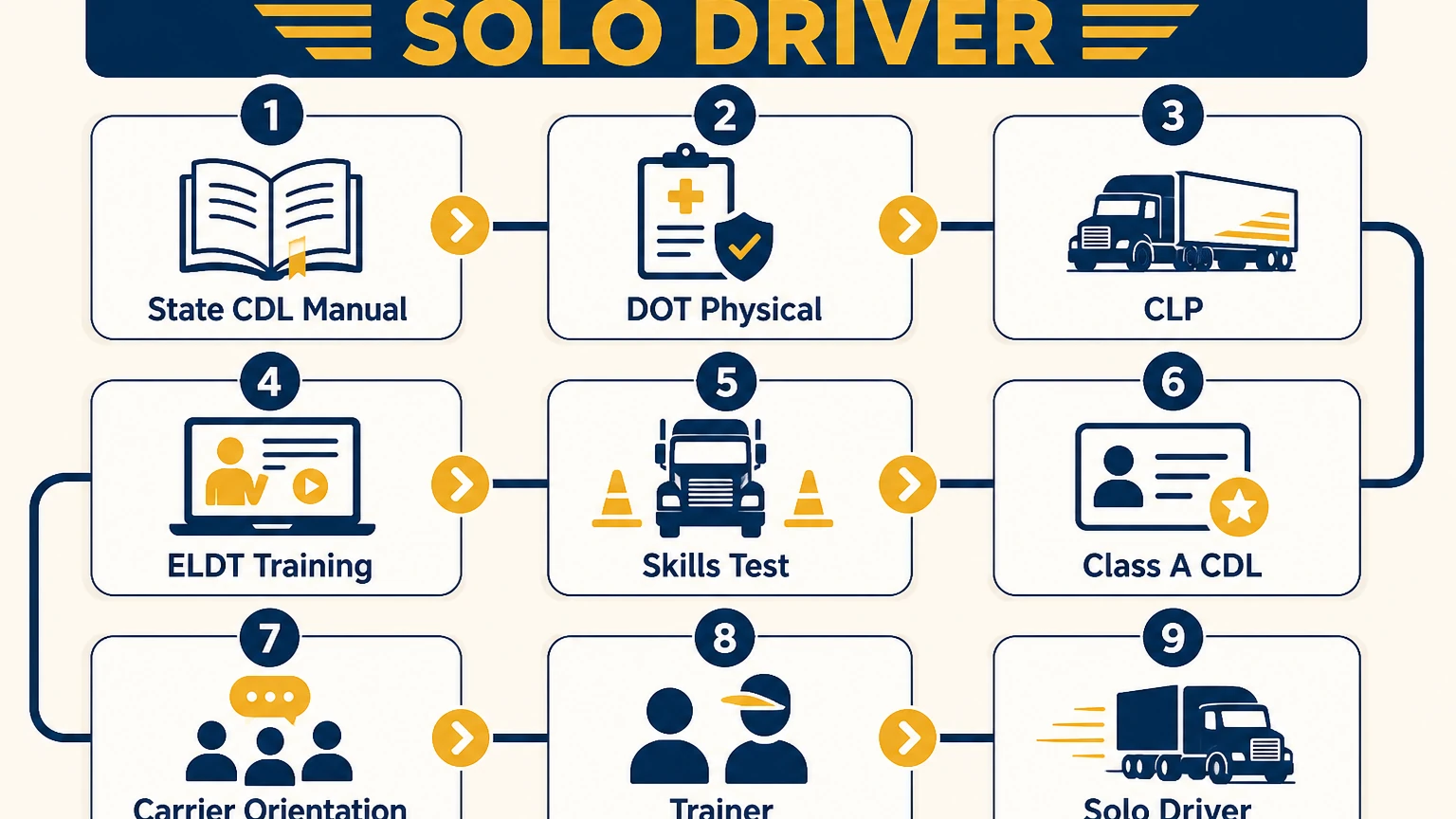
Choose Class A → Study Your State CDL Manual → Meet Medical Requirements → Get a CLP → Complete ELDT → Practice Driving → Pass the CDL Skills Test → Receive Your CDL → Get Hired → Complete Carrier Training → Begin Driving Solo
The CDL itself is only the beginning.
Your first months on the road will teach you how to back into real loading docks, manage Hours of Service, find truck parking, inspect equipment, scale loads, communicate with dispatch, handle difficult customers, drive in bad weather, and make safe decisions when the original plan fails.
Do not rush the process simply because you want to start earning money sooner.
Choose a legitimate training provider.
Take behind-the-wheel practice seriously.
Protect your driving record.
Ask detailed questions before accepting your first job.
And use your first year to build the experience that can open the door to better-paying, more specialized, or more predictable trucking jobs later.
A new CDL gives you permission to begin a professional trucking career.
Experience, safety, and good decision-making are what turn that CDL into a long-term profession.